


Archive for the ‘News’ Category

Ishihara’s resignation doesn’t come cheap

Thursday, November 22nd, 2012

Naoki Inose, shoo-in for governor

On Nov. 21 Naoki Inose, the vice governor of Tokyo Prefecture under Shintaro Ishihara, who decided to cut his tenure short and make a run for national office, finally announced his candidacy for the governor’s seat. That contest will be decided in a special election set for Dec. 16, the same date on which the nation will vote for a new Lower House.

Inose, a writer by trade who belongs to no party, is virtually assured of winning because he has not only been endorsed by Ishihara himself, but also by the Liberal Democratic Party, the Komeito, Your Party and, naturally, Nihon Reformation Party, which just absorbed Ishihara’s fledgling Sunrise Party. There will be at least four other candidates running for Tokyo governor, but media say they have almost no chance.

Because Inose is considered a shoo-in, some people are wondering: Why bother with an election? According to the law, if the governor resigns or dies or otherwise leaves office before his or her term is up, an election has to be held to choose a new governor. The vice governor only takes over until an election is held. What bothers some residents of Tokyo is that it costs about ¥5 billion in taxpayer money to hold an election for Tokyo governor, which gives those residents one more reason to resent Ishihara’s capriciousness. He was only 19 months into his fourth term when he quit.

However, it should be noted that the new governor will be elected to a full four-year term, which means the next election will be in December 2016, not April 2015, which is when it would have taken place had Ishihara remained in office. Since vice governors — and there are four — are appointed by the governor after he assumes office, they are not chosen by the people, so rather than let a vice governor take over the remaining time it is considered democratically proper to simply hold a new election when a governor leaves prematurely, which has only happened once before in Tokyo. The problem is that the Tokyo prefectural assembly elections have always been held at the same time as the governor’s poll, but a representative of the Tokyo election authority told us the next assembly elections will take place as previously scheduled, in April 2015, which means the prefecture will now have to pay for two elections rather than one.

The capital’s is by far the most expensive governor’s race in the country, the closest being Osaka’s, which costs about half as much to carry out. Most prefectures spend about ¥1 billion. Much of the money is used for publicity. Since Japan has a resident registration system, citizens do not have to register to vote the way they do in the U.S., but that also means the local government has to send a notification to every eligible voter. A lot of money is also needed to make and erect thousands of signboards for the election and hiring staff to work at polling places. Tokyo has about 10 million eligible voters and the prefecture gets a fair return on its considerable investment. In the last two governor’s elections, the turnout was over 50 percent, which many not sound like much but is pretty good by recent standards. In 2011, only 25 percent of Saitama’s eligible voters turned out to elect that prefecture’s governor. Also, because the election for the Lower House is occurring on the same day, Tokyo may save a bit of money in terms of personnel costs.

Clarifying the economic damage of the Senkakus row

Wednesday, October 17th, 2012

Prepare for descent.

Japanese conservatives contend that people should not get “emotional” about the economic consequences of the current row with China over the Senkaku islands, implying that some things are more important than money. But what exactly are the economic consequences given that since 2009 China has been Japan’s biggest trading partner?

According to the Finance Ministry, one-fifth of total Japanese exports in 2010 went to China, while the same portion was 7.7 percent in 2001. A Reuters analysis shows that Japan would suffer mightily if trade stopped, citing an annual loss of ¥12 trillion if exports went down to zero for only one month. Under such conditions, automobile companies would be the main loser. They’d lose ¥144 billion. Bank of America estimates that 25 percent of all Nissan’s profits are derived in China, 21 percent for Toyota and 16 for Honda.

Moreover, Japanese companies directly invested ¥1 trillion in China in 2011, 60 percent more than what they spent in 2009. China’s Bureau of Statistics says that as of the end of 2010 there were 22,307 joint Japan-China ventures operating in China comprising 3 million workers and accounting for 16 percent of all the country’s foreign-related companies.

Still, the sector that tends to get the most media attention in Japan is tourism, since visitors from China spend more here than visitors from any other country. According to the Asahi Shimbun, China’s state tourism agency, which controls some 5,500 travel agencies all over the country, has stopped selling tours to Japan for the time being. Cancellations of reservations already made amount to about 500 million yuan, or ¥6.2 billion.

For the big vacation week of Oct. 1, there were at least 10,000 cancellations. China said it originally expected to sell some 45,000 individual tour packages to Japan for that week. On the other hand the agency said that the number of Chinese tourists who visited South Korea during the big vacation week was 125,000, a new record. They spent the equivalent of ¥190 billion, according to South Korea’s retailers association. Department stores and duty-free shops, in particular, did booming business.

Japanese companies lose less with cancellations of Japanese tourists going to China, but the cancellations do have an effect on Japanese airlines and tour packagers. Various media have reported that there were around 52,000 seat cancellations on flights between Japan and China as of September 24, with 37,000 on ANA and 15,000 on JAL. Many of these cancellations were Japanese business travelers, who tend to pay premium prices for tickets.

Japanese tour companies suffered, too. China and South Korea are always two of the top three destinations in terms of number of Japanese tourists, and Sankei Shimbun reports there has been a 30-45 percent decrease in the number of tours to these two countries in the second half of the year compared to the same period last year. This negative effect spreads to other sectors, since tourist companies are also not bothering to advertise. They say it would just be a waste of money.

Tax auditors running out of cheaters, ponder purpose in life

Friday, October 12th, 2012

Pandora’s box

You know that the recession is getting serious when even the National Tax Agency is reduced to twiddling its thumbs. The amount of unclaimed income that tax investigators discovered last year was ¥19.2 billion, comprising a measly 189 cases, the lowest since 1978. Moreover, of all the cases they investigated, only 61.9 percent were prosecuted, the lowest rate since 1973.

It should be noted that these numbers actually apply to tax returns or lack of reporting that occurred in 2008, since it takes about three years for the agency to complete an investigation before deciding on whether to pursue prosecution. So these numbers could simply be a temporary dip owing to the fact that 2008 was the year of the Lehman Brothers failure that jump started the whole economic crisis. However, there are other factors at play.

A tax agency official recently told Tokyo Shimbun that “prosecutors’ attitudes” changed after several recent scandals in which the legality of their methods were questioned, in particular that case in Osaka where a prosecutor cooked up evidence to nail a health ministry bureaucrat. Consequently, prosecutors are a bit gunshy about borderline cases that they would have pursued more aggressively in the past. In addition, over the years tax evaders have become more skillful at hiding income thanks to advances in information technology and the globalization of finances.

But a former tax official told Tokyo Shimbun that he thinks the quality of the auditing has also gone down. When he was an investigator, new recruits were trained under the strictest, most punishing circumstances. Veteran auditors put the screws to their underlings to make sure they were tough and relentless in getting as much evidence against tax scofflaws as they could.

Continue reading about a change in tax audits →

New stats about old folks

Wednesday, September 19th, 2012

With the rapid aging of society it pays to pay attention to all the latest economic statistics regarding old people, and lately we’ve come across quite a few. Here are some new numbers about households in which the designated head-of-household is 65 or older, carried in the Asahi and Tokyo Shimbuns.

Keep on pushin’

  • The average monthly income in 2011 was ¥185,000, which is about ¥3,000 less than the average in 2010.
  • About 90% of total income is in the form of government and company pensions.
  • Average spending is ¥221,000 month, meaning that the average household is ¥36,000 in the hole.
  • However, in 2011 average savings for households when there are at least two people stood at ¥22.57 million. Savings among seniors has been increasing gradually since 2008, but the statistic may be misleading since it is heavily weighted toward upper income households newly entering the senior demographic. Median savings is ¥14.6 million.
  • 5.44 million people over the age of 64 worked in 2011, which represents 27.6 percent of the nation’s population over that age; 46 percent of men and 26 percent of women between the ages of 65 and 69 worked.
  • Total number of people over 64 exceeded 30 million in 2011, with 50,000 over the age of 100.
  • As reference, in 2005, when the number of elderly was slightly over 26 million, about 2.2 percent were collecting welfare. The average monthly welfare payment for two-person elderly households in Tokyo was ¥122,000 and for outside of Tokyo ¥94,500. About 47 percent of elderly who received welfare also received some sort of government pension, at an average of ¥46,000 a month.

Fast-food joints hail relaxed rules for U.S. beef, signal end of the world

Saturday, September 15th, 2012

Earlier this month a panel of experts recommended to the health ministry that it relax standards restricting imports of beef from the United States, Canada, France and the Netherlands for animals that are more than 20 months old. The panel suggests that cattle up to 30 months old be allowed for import and sale in Japan.

Get it while it’s cheap: Yoshinoya outlet in Roppongi, Tokyo

The restrictions were implemented in 2005 after BSE, or “mad cow disease,” was discovered in some livestock in the U.S. in 2003. Between 2003 and 2005 beef imports from the U.S. were banned. When the restriction went into effect, the U.S. objected, saying there was no conclusive proof that the age of the animal has anything to do with whether or not it can get BSE, and in any case, the incidence of the disease was extremely small and statistically insignificant. The government panel seems to have agreed with this opinion by saying that the age of the cow has no relationship “to people’s health.” They will give their official evaluation to the health ministry some time this fall, and the regulations should be relaxed by early next year.

Retailers and restaurateurs, especially fast food chains, are happy with the panel’s decision since it means they can start selling more U.S. beef, which is very popular among consumers here because of its higher fat content. More than 60 percent of the beef sold in supermarkets now is Australian, with 20 percent coming from the U.S. and the remainder from domestic producers. Though the American dollar is, for the moment at least, worth less in Japan than the Australian dollar, U.S. beef is more expensive than Australian beef due to the restrictions. In fact, the high yen is the only reason U.S. beef is at all affordable in Japan right now. By limiting U.S. beef to animals less than 21 months old, imports are seasonal and thus more expensive. Only about 20 percent of all cattle in the U.S. is slaughtered at less than 21 months, while 90 percent is less than 31 months. Consequently, almost all the animals slaughtered in the U.S. can be exported to Japan after the new year.

Continue reading about U.S. beef imorts →

Electronics makers lead the way in killing off lifetime employment system

Tuesday, August 7th, 2012

The big domestic economic news this week is the steep slide in stock prices for Sharp Corporation. Japan’s leading liquid crystal display manufacturer has seen its shares fall 73 percent since the beginning of the year due to an oversupply of television sets in a world that no longer thinks Japanese home electronics are the best that money can buy.

If you’re not Takashi Okuda, president of Sharp Corp., you probably don’t have lifetime employment. (Kyoto photo)

The only thing keeping Sharp going at this point is its parts supply business, especially the deal it has with Taiwan-based company Foxconn, which assembles iPhones and iPads for Apple and uses Sharp-manufactured liquid crystal displays. Last week, Sharp announced it was eliminating 5,000 jobs from its worldwide 56,000-person workforce, the biggest employment cut in the company’s history. It is also going to slash management salaries, including the president’s, by 50 percent. Originally, it was only going to be 20 percent.

In terms of pure numbers, Sharp’s cuts are actually modest compared to other electronics makers. Last January, NEC announced it was eliminating 10,000 jobs. Sony also said it would cut 10,000 employees in April. Panasonic, which employs more than 360,000 worldwide, has said it has “targeted” 7,000 positions in its headquarters alone working in office services, R&D and production technology. They will either be transferred to other divisions or subsidiaries, or pressured to take early retirement. And as these companies scale back, affiliated businesses will have to do the same. Renesas, one of Japan’s leading semiconductor makers, which mainly supplied NEC, will have to cut 30 percent of its workforce, the equivalent of 12,000 jobs.

Even the electronics companies that are stable right now, like Toshiba and Hitachi, haven’t escaped the downsizing trend; they just carried out their massive job cutting a few years ago, which is one of the reasons they’re doing relatively well right now and aren’t in the news as much. Another reason is that they’ve moved away from consumer electronics, where the competition is just too fierce.

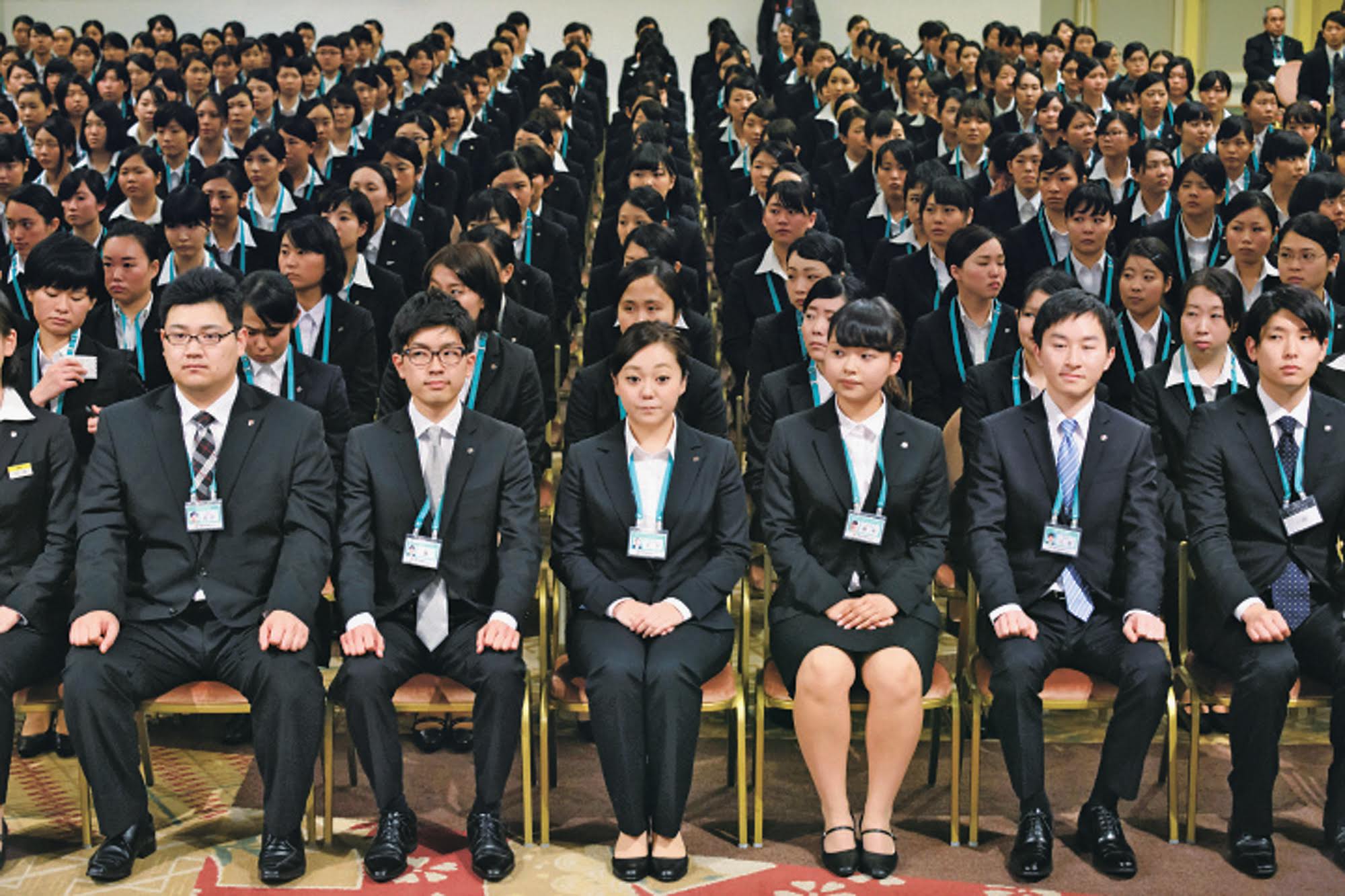
Not surprisingly, home electronics is no longer a field that young university graduates are interested in. Ten years ago, Sony, Panasonic and others of their size were at the top of the wish lists of college seniors, but according to the online version of the business magazine Diamond, all new graduates care about now is getting a position in the public sector. Though the official unemployment rate in Japan is only 4.5 percent, young people know that securing work does not mean security, at least not in the classic sense, so even getting a job with an “excellent company” doesn’t guarantee a job for life. Only the civil service does. The government never restructures.

A survey was carried out by the employment consulting firm, Leggenda Corp., of students who will enter the workforce in 2013. More than 50 percent say their first choice is to work for the government. The Japan Institute for Labor Policy and Training gets more specific. In a survey of 4,000 20-year-old men and women, they found that 87.5 percent will prioritize lifetime employment (shushin koyo) when they look for their first job. These respondents also look forward to “age-based promotions and raises,” another attribute of the old Japanese employment system that has gone the way of the dodo, at least in the private sector. This is the highest percentage on record, which just goes to prove that people really don’t miss their water until the well goes dry.

Breaker, breaker: How to conserve energy without thinking too much

Wednesday, July 4th, 2012

Power trip: electrical panel with 30-ampere main breaker switch

Last Monday the summer setsuden (electricity-saving) campaign started. All the regional utilities except Okinawa’s are requesting that customers cut back on their energy use so as not to put a strain on the grid, which has been compromised by the shutdown of so many nuclear power plants in the wake of last year’s meltdown at the Fukushima No. 1 reactors. As evidenced by the large anti-nuclear demonstrations taking place, a lot of people have strong feelings about atomic energy, but whether you believe it to be too dangerous to handle or an acceptable alternative to carbon-based sources, the best way to address the more pressing issue of energy shortages is to reduce usage.

Though there are many piecemeal methods for saving energy, one way to immediately cut down is to exchange your main circuit breaker, the gatekeeper for the current that flows into your home. Power is measured by means of watts, and the number printed on your breaker, which stands for amperes, represents the maximum amount of wattage that can pass into your home at one time. Different household appliances use different amounts of power. Anything that cooks or produces heat will use more power than other appliances. When the amount of power flowing into your home exceeds the ampere level of your breaker, it automatically trips, causing a blackout, but only in your home. If you use a lot of electricity, then you should install a breaker with a higher ampere number.

In Japan, household breakers come in seven steps, from 10 amperes to 60. The higher the number, the higher the basic charge on your monthly electricity bill. If you are a Tokyo Electric Power Co. customer you pay ¥273 for 10 amperes, ¥409 for 15, ¥546 for 20, ¥819 for 30, ¥1,092 for 40, ¥1,365 for 50 and ¥1,638 for 60. In order to figure out which breaker level is appropriate, take a survey of all your household appliances and how often you use each one.

Continue reading about easy energy consevation →

RSS

Recent posts

Our Users Say

  • Jodi: Thank you for this article. I am recently back in Japan and was surprised how often I needed to re-charge my...
  • Jiro: Not my party, your party!
  • RJ: JR sagi-style profit…“place on the system more of a burden” LOL
  • Colin Doyle: Why is JR too proud or too obtuse to ask the other train companies how they were able to integrate their...
  • Simon: I had a similar experience when I caved in to societal and peer pressure ;-) and got an iPhone 4S last year....
Japan Times RSS Feed

RECENT JAPAN TIMES HEADLINES

  • No items