


Archive for the ‘Economy’ Category

Tax auditors running out of cheaters, ponder purpose in life

Friday, October 12th, 2012

Pandora’s box

You know that the recession is getting serious when even the National Tax Agency is reduced to twiddling its thumbs. The amount of unclaimed income that tax investigators discovered last year was ¥19.2 billion, comprising a measly 189 cases, the lowest since 1978. Moreover, of all the cases they investigated, only 61.9 percent were prosecuted, the lowest rate since 1973.

It should be noted that these numbers actually apply to tax returns or lack of reporting that occurred in 2008, since it takes about three years for the agency to complete an investigation before deciding on whether to pursue prosecution. So these numbers could simply be a temporary dip owing to the fact that 2008 was the year of the Lehman Brothers failure that jump started the whole economic crisis. However, there are other factors at play.

A tax agency official recently told Tokyo Shimbun that “prosecutors’ attitudes” changed after several recent scandals in which the legality of their methods were questioned, in particular that case in Osaka where a prosecutor cooked up evidence to nail a health ministry bureaucrat. Consequently, prosecutors are a bit gunshy about borderline cases that they would have pursued more aggressively in the past. In addition, over the years tax evaders have become more skillful at hiding income thanks to advances in information technology and the globalization of finances.

But a former tax official told Tokyo Shimbun that he thinks the quality of the auditing has also gone down. When he was an investigator, new recruits were trained under the strictest, most punishing circumstances. Veteran auditors put the screws to their underlings to make sure they were tough and relentless in getting as much evidence against tax scofflaws as they could.

Continue reading about a change in tax audits →

New stats about old folks

Wednesday, September 19th, 2012

With the rapid aging of society it pays to pay attention to all the latest economic statistics regarding old people, and lately we’ve come across quite a few. Here are some new numbers about households in which the designated head-of-household is 65 or older, carried in the Asahi and Tokyo Shimbuns.

Keep on pushin’

  • The average monthly income in 2011 was ¥185,000, which is about ¥3,000 less than the average in 2010.
  • About 90% of total income is in the form of government and company pensions.
  • Average spending is ¥221,000 month, meaning that the average household is ¥36,000 in the hole.
  • However, in 2011 average savings for households when there are at least two people stood at ¥22.57 million. Savings among seniors has been increasing gradually since 2008, but the statistic may be misleading since it is heavily weighted toward upper income households newly entering the senior demographic. Median savings is ¥14.6 million.
  • 5.44 million people over the age of 64 worked in 2011, which represents 27.6 percent of the nation’s population over that age; 46 percent of men and 26 percent of women between the ages of 65 and 69 worked.
  • Total number of people over 64 exceeded 30 million in 2011, with 50,000 over the age of 100.
  • As reference, in 2005, when the number of elderly was slightly over 26 million, about 2.2 percent were collecting welfare. The average monthly welfare payment for two-person elderly households in Tokyo was ¥122,000 and for outside of Tokyo ¥94,500. About 47 percent of elderly who received welfare also received some sort of government pension, at an average of ¥46,000 a month.

Home centers forcing JA to improve its game for farmers

Monday, September 10th, 2012

Komeri outlet in Sakae Town, Chiba Prefecture

The Central Union of Agricultural Cooperatives, more commonly known by the acronym JA (for Japan Agriculture), or the Japanese abbreviation Nokyo, has, in one form or another, controlled the finances and structure of the country’s farm sector since the early 1950s. That means not only does JA help keep prices high so that farmers can make a living, but provides farm families with everything they need to make that living, from loans to sales of equipment, supplies and fertilizer. It even sells insurance and does banking, under an exception granted by the central government. As with any semi-public organization that has a given field to itself, JA’s operations have become sclerotic over the years. In 2008, the agricultural ministry conducted a survey of farmers. When asked where they bought their fertilizer, 70 percent answered “JA,” but 80 percent of these farmers also answered that they were “dissatisfied” with the cooperative’s prices.

JA is famous for using a lot of middlemen in their sales channels, which invariably drives up the prices of everything they sell. In addition, various handling fees and distribution costs make the prices even higher. In a recent Asahi Shimbun article a professor at the Tokyo University of Agriculture said that with the recession and the possibility of more imports coming into the Japanese market, farmers have become extra sensitive about costs and as a result are beginning to wonder if JA is really looking after their interests properly. Some have already started leaving the cooperative.

But where to go? According to the agricultural ministry survey, only 2.5 percent of farmers were buying their fertilizer from so-called home centers in 2008, but that portion has likely gone up considerably since then. Home centers, called home improvement centers in the U.S., are large retail outlets that sell everything for the home, but mainly supplies that homeowners need for things like repairs or renovations, as well as gardening and landscaping. The Japan DIY (Do-It-Yourself) Association reports that there were 4,310 home centers in Japan in 2011, double the number that existed in 1990. The home center chain with the most outlets is Komeri, who own more than a thousand. And while home center sales have mostly been stagnant since 2005 owing to the growth of other retail models, mainly drug stores, Komeri is also growing. The chain says it plans to double its present number of stores in 10 years’ time.

Continue reading about home center Komeri →

Electronics makers lead the way in killing off lifetime employment system

Tuesday, August 7th, 2012

The big domestic economic news this week is the steep slide in stock prices for Sharp Corporation. Japan’s leading liquid crystal display manufacturer has seen its shares fall 73 percent since the beginning of the year due to an oversupply of television sets in a world that no longer thinks Japanese home electronics are the best that money can buy.

If you’re not Takashi Okuda, president of Sharp Corp., you probably don’t have lifetime employment. (Kyoto photo)

The only thing keeping Sharp going at this point is its parts supply business, especially the deal it has with Taiwan-based company Foxconn, which assembles iPhones and iPads for Apple and uses Sharp-manufactured liquid crystal displays. Last week, Sharp announced it was eliminating 5,000 jobs from its worldwide 56,000-person workforce, the biggest employment cut in the company’s history. It is also going to slash management salaries, including the president’s, by 50 percent. Originally, it was only going to be 20 percent.

In terms of pure numbers, Sharp’s cuts are actually modest compared to other electronics makers. Last January, NEC announced it was eliminating 10,000 jobs. Sony also said it would cut 10,000 employees in April. Panasonic, which employs more than 360,000 worldwide, has said it has “targeted” 7,000 positions in its headquarters alone working in office services, R&D and production technology. They will either be transferred to other divisions or subsidiaries, or pressured to take early retirement. And as these companies scale back, affiliated businesses will have to do the same. Renesas, one of Japan’s leading semiconductor makers, which mainly supplied NEC, will have to cut 30 percent of its workforce, the equivalent of 12,000 jobs.

Even the electronics companies that are stable right now, like Toshiba and Hitachi, haven’t escaped the downsizing trend; they just carried out their massive job cutting a few years ago, which is one of the reasons they’re doing relatively well right now and aren’t in the news as much. Another reason is that they’ve moved away from consumer electronics, where the competition is just too fierce.

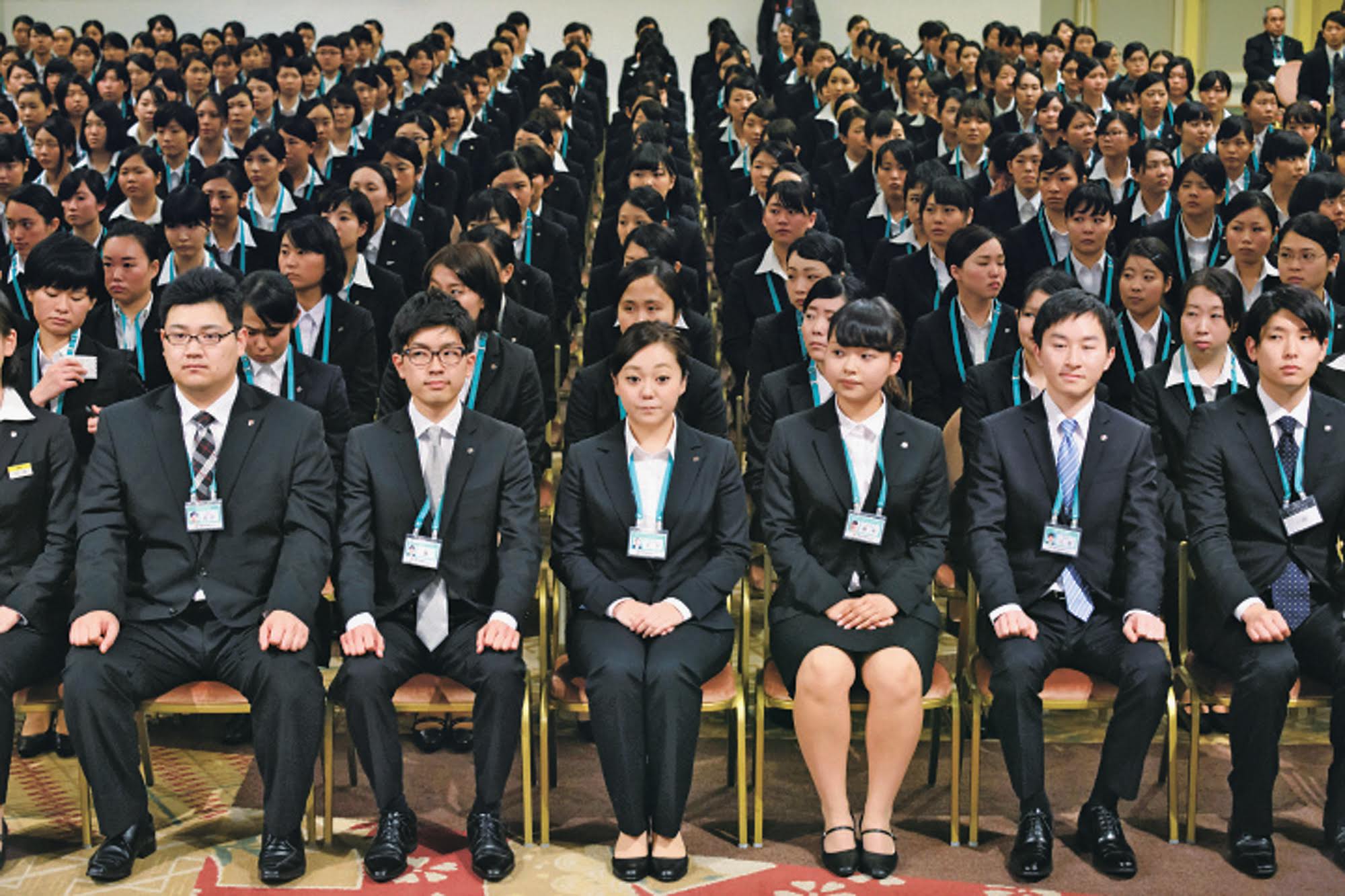
Not surprisingly, home electronics is no longer a field that young university graduates are interested in. Ten years ago, Sony, Panasonic and others of their size were at the top of the wish lists of college seniors, but according to the online version of the business magazine Diamond, all new graduates care about now is getting a position in the public sector. Though the official unemployment rate in Japan is only 4.5 percent, young people know that securing work does not mean security, at least not in the classic sense, so even getting a job with an “excellent company” doesn’t guarantee a job for life. Only the civil service does. The government never restructures.

A survey was carried out by the employment consulting firm, Leggenda Corp., of students who will enter the workforce in 2013. More than 50 percent say their first choice is to work for the government. The Japan Institute for Labor Policy and Training gets more specific. In a survey of 4,000 20-year-old men and women, they found that 87.5 percent will prioritize lifetime employment (shushin koyo) when they look for their first job. These respondents also look forward to “age-based promotions and raises,” another attribute of the old Japanese employment system that has gone the way of the dodo, at least in the private sector. This is the highest percentage on record, which just goes to prove that people really don’t miss their water until the well goes dry.

Boomer boom: Businesses tapping consumption where they can find it

Friday, July 20th, 2012

It’s 10 a.m. Do you know where your grandmother is?

In July, the Bank of Japan released the results of its quarterly tankan survey of business sentiment for April-June. The most notable, and hardly surprising, result was the drop in confidence among major manufacturers. Less was said about the fact that domestic demand and individual consumption appear to be stabilizing. The numbers get even more encouraging when you look at specific industries.

In the tankan, an index of “0″ means no change in sentiment, with minus numbers indicating a loss of confidence and positive numbers a gain in confidence. The index for hotels and restaurants was +3, the first positive rise in five years, and a substantial one. Even more impressive was the index for “individual services,” such as travel agents, a category launched in 2004. The most recent tankan showed an index of +25. These numbers are at once heartening and baffling. Average income did not rise during the same period, which means consumption shouldn’t have risen, so why the increase in confidence?

The report’s authors credit these hopeful signs to people over 60, and smaller businesses’ resourcefulness in tapping this demographic. A recent article in Tokyo Shimbun profiled an izakaya (drinking establishment) chain called Hokkaido, which has an outlet in Kokubunji, Tokyo, that offers a special hiru enkai (daytime party) plan: If each member of a party orders at least ¥3,500 in dishes, then the party can drink as much as they like without paying extra.

Continue reading about senior citizen consumers →

Place your bets: Local governments pray for a jackpot

Tuesday, July 10th, 2012

Take my money, please

Japan’s biggest-ever lottery offering went on sale July 9. The 2012 Summer Jumbo Takarakuji  has 26 grand prizes of ¥400 million each — tax free. The last Jumbo lottery was in February, with a top prize of ¥300 million, but in March the authority that oversees the contest increased the maximum possible prize from ¥300 million to eventually reach ¥750 million. The strategy is to gradually increase the amounts of the jackpots in order to boost sales on a continuing basis.

The authority is called the Zenkoku Jichi Takarakuji Jimu Kyogikai, or Zenkokukyo for short. It means, literally, national self-government lottery administration council, and is made up of finance section heads of prefectural governments and large cities. The headquarters are located in the Tokyo Metropolitan Government offices, which makes sense. More lottery tickets are sold in Tokyo than anywhere else.

According to research carried out by the Nihon Keizai Shimbun, ¥173 billion worth of lottery tickets were sold in Tokyo in 2007, meaning per capita sales were ¥14,278. The next largest sales amount was recorded by Osaka, with ¥98 billion. About 46 percent of nationwide revenue becomes prize money, with 40 percent going to prefectural and city governments, and the remainder is used for administrative and other costs. The amount that each local government receives is determined by how many tickets each has sold.

Continue reading about lottery jackpots →

How high is up: Tokyo Skytree boosts economy for some

Thursday, May 31st, 2012

There’s a Japanese proverb that goes something like: Smoke and stupidity always rise to the highest places. It’s a useful saying when talking about the media frenzy regarding the Tokyo Skytree, which opened to the public May 22. Though it’s not our mission to ponder the psychology of why people like to go to the top of very tall structures and look down on everyone else, whatever the attraction, it hardly justifies the redundantly blanket media coverage of the new broadcast tower in Tokyo’s Sumida Ward. Of course, the Tobu Railway group, which owns and operates the tower, couldn’t have asked for better publicity. The number of visitors has so far exceeded its own estimates by 50 percent. No one has bothered to calculate the equivalent value in advertising that this free PR represents but it must

Skytree crowds on opening day (Satoko Kawasaki photo)

be in the billions of yen. And it’s paid off. As of last February, group reservations for tickets to the upper observation deck were booked until July 22, amounting to some 300,000 separate admissions. Because a number of people cancel on a daily basis, the operator of the 634-meter tower has decided to sell an additional 1,000 tickets a day to the lower observation deck (350 meters) between June 4 and July 10 at ¥2,500 a pop. The limit for daily admissions is 14,000, but after cancellations the number that have actually shown up is between 12,000 and 13,000. Altogether, 1.4 million
visitors have been in the tower, 85,000 of whom went to the upper observation deck (450 meters), which costs ¥3,500. Reservations must be made with a credit card (only those issued in Japan are acceptable), and there are no refunds. At those prices and those numbers, it should be no problem for Tobu to pay off its massive ¥400 billion construction cost in a matter or years rather than decades.

Tobu isn’t the only party counting on the Skytree to boost its financial situation. Tokyo Shimbun reports that the “economic impact” of the tower should also be felt nationwide to the tune of ¥174.6 billion and in the Tokyo metropolitan area by as much as ¥130 billion. Even more impressive, Sumida Ward expects ¥88 billion, and that’s just in income. Of the eight Tokyo districts where property values rose in 2011, two are in Sumida Ward near the Skytree. However, according to the Mainichi Shimbun there is some talk among Sumida residents of just how much they themselves will benefit in the balance. About 32 million people a year are projected to come to Tokyo Skytree Town and its retail complex Solamachi, which is considerable given that annual admissions to Tokyo Disneyland and Disney Sea total 25 million. But the surrounding area is more residential than commercial and while local merchants are trying to make the most of the tourist windfall, those who simply live there are wondering if the boost is worth all the trouble. How the influx compromises public safety

RSS

Recent posts

Our Users Say

  • Jiro: Not my party, your party!
  • RJ: JR sagi-style profit…“place on the system more of a burden” LOL
  • Colin Doyle: Why is JR too proud or too obtuse to ask the other train companies how they were able to integrate their...
  • Simon: I had a similar experience when I caved in to societal and peer pressure ;-) and got an iPhone 4S last year....
  • goyaty: E-Mobileは、酷いサービスとサポート する。そのため、私も契約を更新しな でWiMAXに移った。WiMAXは、1年...